
One of the most important questions people who want to develop mobile applications for Android and iPhone usually ask is: “How can I reach my customers?” or “Do my customers actually want the app I’m building?”
Developing and designing an Android or iPhone app that attracts attention and generates revenue requires you to focus on these two questions and explore innovative ways to ensure the app’s success and promote it effectively. The easiest way, of course, to reach customers is to spend money on digital or television advertising. However, advertising does not prove the validity of the concept behind your app, nor does it necessarily generate revenue.
Money comes from customers who think of your product as a generic symbol for its category, just as Facebook is associated with social media and Google with search.
Design your app now: [View our portfolio and contact us to develop your Android (Galaxy) and iPhone (Apple) app.]
This article discusses two of the most important aspects that can contribute to the success of the mobile application you design and develop: how to reach your customers and how to determine whether they actually want your app.
Paul Graham recently wrote: “Sometimes the trick is to deliberately focus on a narrow market. It’s like reducing the size of a heating fire at first, then gradually adding more wood to it.”
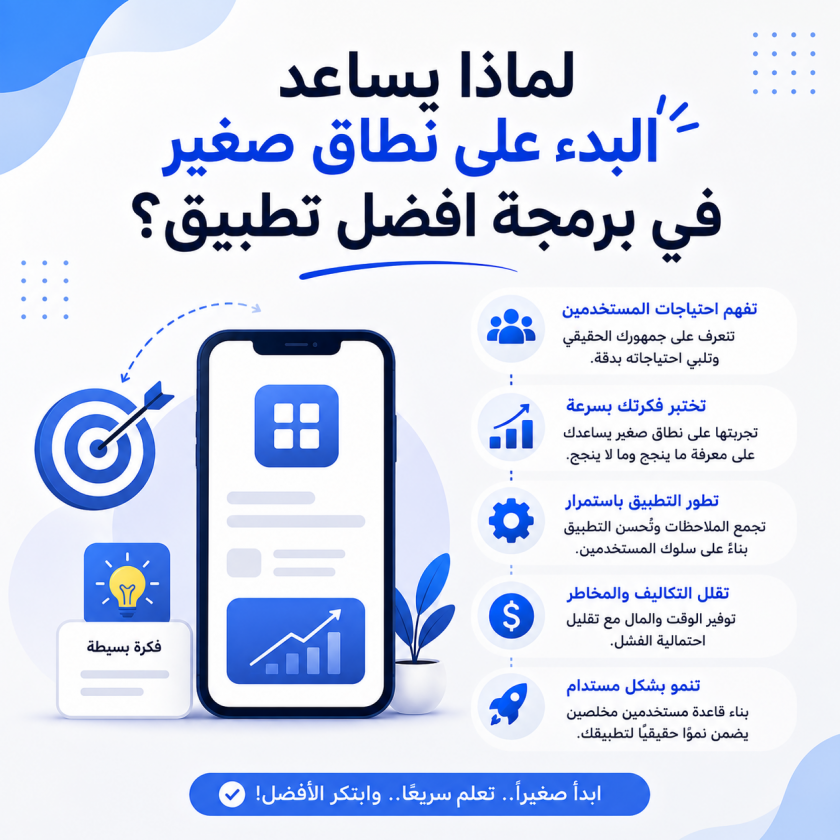
When building an application, do not try to attract your entire potential customer base from the beginning. The cost will be extremely high, and your competitors may take advantage of the mistakes you make during your product’s first trial. Instead, consider starting on a small scale and developing an app for a specific, narrowly defined audience.
In most cases, you do not know whether your application will succeed or fail. The best way to find out is to have real customers use it.
This is exactly the principle that Facebook followed. Mark Zuckerberg initially launched the platform exclusively for Harvard students. Once people realized how valuable the product was, Zuckerberg expanded it and began making it available to other universities.
When you build an application for a small group of users, you also have the opportunity to limit the number of people who see your initial mistakes. At the same time, you can improve your application to better meet your customers’ needs by monitoring their behavior through statistics and analytics and using those insights to improve your product. This ultimately leads to a better mobile application.
Read also: Why Does Starting Small Lead to Better App Development?
When you begin designing and developing an application for a specific audience in order to gain a clear understanding of your product strategy, would you rather take the easy route and spend a considerable amount of money on Facebook or Google ads, or make the most of every dollar you spend by personally earning your customers’ trust and directly learning about their impressions and feedback?
Some customers will be willing to purchase your application at an early stage. They are often people within your personal or professional network, as well as your social media followers. These customers can help spread your brand when they receive significant attention and genuine value from your product.
These early customers are also likely to know people within their own circles and can help you achieve greater reach through positive feedback about your product. Positive word-of-mouth is one of the most powerful forms of attraction.
You can gradually increase the number of customers week after week by focusing on making small improvements and strengthening the power of compounding growth.
Graham also wrote: “If you have 100 users, you need 10 more next week to achieve a 10% weekly growth rate. Although 110 may not seem much better than 100, if you continue growing at 10% every week, you will be surprised by how large the number becomes. After one year, you will have around 14,000 users, and after two years, around two million users.”
When seeking press coverage, you should focus on publications that operate in your city and the bloggers who write for them. Once you obtain that initial press coverage, you can gradually expand your geographic reach to the state or region, and eventually to local and international markets, depending on the impact your product creates.
If you successfully apply these two approaches, there is little reason for your application to fail to attract customers and take advantage of compound growth.
Ultimately, business in general is built around two fundamental principles: innovation and marketing.
Translated and adapted.
Read also: The Difference Between the Various Types of Applications in Terms of Development, Cost, and Time.